Introduction
The professional development of teachers becomes major consideration in planning educational reforms and school improvement (Guskey, 2000). Many result of research in the field of teachers’ professional development shows that effective professional development has positive effects on teachers’ competency and skill which indirectly influence the learning outcomes (Darling-Hammond and Sykes, 2003). Traditionally, the program relates to activity where teachers listen passively to ‘experts’ (Clarke & Hollingsworth, 2002). Yet, there is another way of teachers’ development that pay more attention to teachers as learners and school as learning communities (Clarke & Hollingsworth, 2002). Professional Learning Community (PLC) is a concept of teacher development that has been moved from traditional paradigm where teachers share their expertise either with their peers in the school or with their professional colleagues in other schools (Grossman et al., 2001).
In Indonesia, the government has a strong commitment to education sector to allocate at least 20% of the local budget for education. Although, there is some significant progress on the quantity of education provision, the quality of education becomes the major issue that needs to be solved (The World Bank, 2012). Dealing with this problem, therefore, the government of Indonesia focus on how to create better outcomes through improved quality of learning. Increasing teacher quality standard becomes one of the critical programs of improvement. It has been done through training, teacher education, and the latest one, certification. (The World Bank, 2012). One of Indonesia’s government project which is to improve teachers’ skill and competency that relates to PLC is the Subject Teachers Forum (MGMP) (Kemdikbud, 2009). Just like the concept of PLC in western context, MGMP also utilises the sharing knowledge among the member of the community (teachers).
This paper will discuss the broad literature and research on PLC as well as its implementation in the form of MGMP as the practice of PLC in Indonesia. At the end, I will investigate some challenges that faced by MGMP and KKG that need to be tackled by the education policy actor in Indonesia.
Professional Learning Communities
The notion of professional learning community (PLC) is commonly linked to the study of school development. However, originally, its root is study of professional development (Liebermann, 1998) and learning communities (Argyris, 2001). It does not only focus on individual teacher’s learning, but also on the professional learning which can develop its collective knowledge through collaborative exploration and evaluation (Stoll & Louis, 2007).
An effective PLC “has the capacity to promote and sustain the learning of all professionals in the school community with the collective purpose of enhancing pupil learning” (Stoll et al., 2006, p. 3). There are two assumptions that support PLC. The first, it is assumed that knowledge is experienced by teachers in their daily lives and better comprehended through sharing with others who have similar experiences. And the second, it is assumed that teachers’ engagement towards PLC will improve their professional knowledge and amplify students’ engagement in learning (Buysse, Sparkman, & Wesley, 2003).
From the explanations above, it is concluded that a PLC should be consists of a group of professionals (teachers) who share their collective goals and purposes, persistently acquiring new knowledge through collaborative activity to improve their teaching practice which will affect students’ learning. In other word, technically, Hord (1997) in Sigurðardóttir (2010) explain PLC as a cycle where teacher’s learning is a part of daily routines; teachers obtain new knowledge, try it out in the classroom, and, from the experience, they gain yet more understanding and knowledge. They discuss and share their experience interactively with the communities where their experiences will be also critically evaluated and reflected to obtain new knowledge that can be implemented in the next cycle. This cycle is significantly influenced by: the structure of the school; the school culture that depends on the teachers’ beliefs and values; and the leadership model, which significantly influences both culture and structure.
According to Stoll et al (2006), to be effective, there are some important consideration in implementing PLC namely:
Shared values and vision. Huffman’s (2011) investigation in 18 schools about the role of shared vision in creating PLC shows that the school more successful in establishing PLC when the vision and values are clearly shred to the staffs. Moreover, different vision among colleague can potentially reduce teacher efficacy since the teachers are not be able to get reinforce from the other staffs (Louis et al., 1995).
Collective responsibility. The schools are collectively organized into a setting where the staffs (and students) are committed to the school vision and values. They worked together to reach the vision. All staff members see themselves as responsible for the total development and the success of students (Hord, 1997). Newman and Wehlage (1995) in Chiptin (2014) explain that collective responsibility will strengthen the commitment and attract those who reluctantly follow the community.
Reflective professional inquiry. It involves a dialogue between peers on educational issues and problems in applying a new knowledge in the classroom, teaching practice, instructional design, supervision, and curriculum development (Louis et al., 1995). It also related to knowledge sharing through interaction (Fullan, 2001), together finding solution to students’ problems and needs (Hord, 1997).
Collaboration. It deals with the involvement of staffs in every developmental activity which need exchange of helps and supports amongst several teachers such as peer supervision and review (Louis et al., 1995). One staff with another staff are interconnected with the same purpose to provide better teaching and learning experience in the classroom.
PLC’s Impact on School Effectiveness
Sigurðardóttir (2010) conducted his research on PLC in two phases. The first is survey which was to know the correlation between school effectiveness and PLC. It is found a significant correlation between the effectiveness level of schools and their level of PLC. All variables of PLC in school A (effective school) such as shared vision, shared leadership, mutual support among staffs, collaborative learning and social climate have higher mean score than the school B (less effective school). The second phase was experimental study where an intervention was made in the school C to improve the level of the PLC and evaluate its impact to the pupil’s outcomes. Although it did not make significant change on the variables of PLC, the interventions raised the students’ achievement in national test, especially in mathematics.
Another research, Louis and Marks (1998), by using a mixed method design, carried on a multi-site investigation about PLC’s impact in 24 schools. It investigated the correlation between the classroom pedagogy quality and PLC characteristic level. It is found that the existence of PLC in a school is conducive to the more support from school’s community for higher quality of pedagogy. It is noted that PLC affects 36% of variance in the quality of classroom pedagogy, which means there are other variances beside PLC that affect the pedagogy.
In the large-scale research conducted in England, Bolam et al. (2005) investigated the correlation between PLC characteristics of schools with the students’ outcome. The data was gained from a national pupil assessment database. They found a significant link between the strength of PLC characteristics and student achievement at both primary and secondary schools. Although it is not a strong correlation, but it shows positive relationship. From the research, it is concluded ‘‘the greater the extent of reported staff involvement in professional and pupil learning, the higher was the level of pupil performing and progress in both primary and secondary schools’’ (p. 132).
Through a meta-analysis Vescio et al (2008) summarises the way PCL impacts school effectiveness. By actively participating in PLC, the teaching practices changes into more students centred. Teaching culture is also positively affected since the community increases collaboration, teacher empowerment and continuous learning.
Although it cannot be generalised in all situation, that four research have proven that there is relationship between PLC and school effectiveness. The findings indicate that PLC in a school provides opportunity to make a better result of teaching and learning. PLC also supports school’s change through collaborative activity amongst staffs. However, it cannot be avoided that in every correlational research, other variables also contribute in school improvement. So that, PLC is not always the only variable that affect improvement.
Subject Teacher Forum (MGMP) as Professional Learning Community in Indonesia
Subject Teacher Forum or well known as MGMP is a well-known professional development among teachers in Indonesia. MGMP concerns on how to develop professionalism of teachers through the forum of peers. The forum is usually in the form of discussion, workshop, seminar, and peer teaching. It is held periodically (usually once a month) with the aim of encouraging an increase in the quality of teaching and teacher competence.
The Indonesia government encourage the teachers to be actively involved in MGMP. That is the reason there are many regulation related to this forum. According to Ministry of Education Regulation about Subject Teacher Forum (Depdiknas, 2009) “MGMP is a forum of professional activities of teachers who teach similar subjects in a particular area (regency, city, or province) consisting of two elements: deliberation and subject teachers. Deliberation reflects the activities of, by, and for teachers, while subjects are state or private primary or secondary school teachers who take care and are responsible for managing the subjects set out in the curriculum”. The concept of MGMP is a self-help professional development activity in the local level area where the teachers work. So, this is not a forum of teachers in a particular school but this forum is conducted by the teachers within schools. According to the guideline published by the Directorate General of Teachers and Educational Staffs (2010, p.6), the subject-teacher forum has 5 objectives as follows:
- To encourage teachers to improve their knowledge and skills in planning, implementing, and evaluating teaching learning activities.
- To share problems in daily teaching practice and solve the problems according to the characteristics of subjects, teachers, and school and community conditions.
- To provide teachers with the opportunity to share information and experiences in curriculum implementation and science-technology development.
- To provide teachers with the opportunity to share ideas for improvement of their knowledge.
- To build collaboration with other institutions to create conducive, effective, and joyful learning.
Yulia and Devi (2017) adds the key principles in conducting MGMP in local context include: collaboration which focus on practical rather than theoretical knowledge; grass-roots support which concern on topics that relate to the local context; and the capacity for on-going consultation and discussion during the progress of programs.
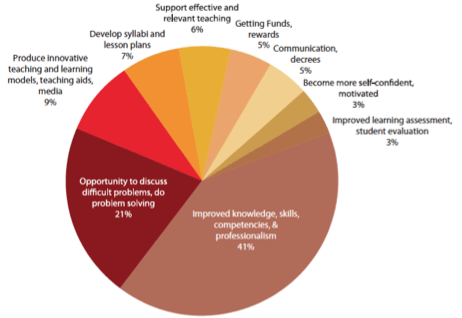
When looking closely at the MGMP’s roles and objectives above, it appears that the MGMP is a means of subject teachers who works collaboratively in broadening their insights and knowledge to create an effective, efficient, enjoyable, and educative learning process. As a professional community of particular subject, the MGMP is expected to solve the problems faced by both teachers in terms of subject characteristics, school environment conditions, curriculum implementation, methodology and adjustments to the development of science and technology. In addition, MGMP also plays a role in improving and equalizing the ability of teachers in preparing, implementing and evaluating the program of teaching and learning activities. According to a survey by Ragatz and Kesuma (2009), by far the most common response of teachers was that MGMP improved their knowledge, skills, competencies, and professionalism. Teachers also confirmed that MGMP was an ideal forum where they can discuss difficult problems and seek solutions. The problems are usually about how to teach a difficult topic to dealing with issues faced in a specific classroom.
In 2010, Ministry of Education and Culture conducted a study to estimate the total number of MGMP in Indonesia (Kemdikbud, 2011). From 35 districts, there were 267,000 teachers were participating in a total of 6,155 MGMP. On this basis, it can be estimated that there are well over 60,000 forums in Indonesia. This huge amount of MGMP leave some problems. Since MGMP is a self-help activity held by teacher, there is difference quality from one district to another district. It is confirmed by the research of Soebari and Aldridge (2016) where there is significant difference in the degree of effectiveness of MGMP between rural and urban area in Indonesia. In addition, Chang et al (2014) reported that support for MGMP are different over the years, and although many are still active and productive, a large number have become inactive or fail to provide effective support for professional development. They often grow stronger and sometimes get weaker again depending on the support of the district education authority or the teacher’s scrutiny.
To find an ideal condition of MGMP in Indonesia context, World Bank (2009) through a comprehensive study in 30 districts in Indonesia, reports an ideal condition where MGMP can works effectively. It confirmed the central features of the best MGMP which can be seen as follows:
- Sizes of approximately 10–12 schools for an MGMP (cluster of subject-based secondary teachers from a group of high schools)
- Biweekly working meetings (approximately 16 meetings per year)
- Financial and technical support and frequent visits from the district education staff, supervisors, and principals
- Focused meetings that last approximately four hours
- Small-group work
- Nearly full attendance by all teachers in the school cluster working group
- Office-bearers consisting of at least a chair, a secretary, and a treasurer
- A focus on providing core activities such as the development of syllabi and lesson planning, discussions of subject matter, the development and practice of active and innovative teaching methods, the design of teaching aids, and student testing and achievement
Some case studies in some districts have linked between MGMP and school effectiveness. Hidayati (2010) found that there is significant positive correlation between being active in MGMP and teacher’s competency from their study in a district in Indonesia. Hidayah (2015) also investigated the effect of Mathematics MGMP on the teacher’s ability which results is significant. They compared the way of the teacher’s in teaching mathematics before and after being actively involved in MGMP. The two cases do not automatically prove that if the teachers join MGMP, the students’ outcome will be dramatically improved. It shows that there is an opportunity to provide better teaching and learning process when teachers optimise MGMP as the place to improve their professionality. Until now, PISA result still shows that Indonesia needs a lot of improvement especially in teaching and learning to have better students’ outcomes. In 2013, Indonesia was the second lowest among 72 countries that join PISA (The Conversation, 2016). Ministry of Education (2016) also reported that from 33 provinces in Indonesia, only 7 of them whose the average score of teacher competence test are above the passing grade. It means, more than a half teacher in Indonesia need improvement. Thus, optimising Professional Learning Community through actively involved in collaborative learning like MGMP is a necessity for Indonesian teacher. For that reason, it is important to analyse factors that disturb the effectiveness in conducting MGMP during this time.
Analysing the Main Challenges of MGMP
The successful of teacher professional development is usually handicapped by many factors. According the World Bank (2009), in some cases, the MGMP does not run effectively due to some factors from internal and external of the teacher. From internal teachers, it deals with their commitment in developing their professionalism. It is confirmed by the report of USAID (no date) that there are cases where the schedule of MGMP are already announced in advance and head teachers permit teachers not to teach on those days, but some teachers are absence the MGMP activities because they feel that MGMP days are time for them to have a rest so that they are lack of enthusiasm to attend the MGMP activities. It is also because of the teaching time policy that require a teacher in Indonesia to teach at least 24 hours per week (Kemdikbud, 2005) is felt too much for them. It is partly reasonable, since with that teaching time, teacher only has 3 hours per day to do another activity such as making a report, assessing students work, planning to teach, and developing their professionalism.
For external factor, not all subject teachers can attend District MGMP programs because usually the schools only send one or two teachers as representatives. Unluckily, due to the communication problems, sometimes those who join the programs do not share their experience with their colleagues within their own schools (USAID, no date).
Other challenges are also due to a geographical factor. Commonly, the district MGMP meeting is held in the city centre area. It is fairly far especially for teachers from rural areas. Sometimes, because of the limitation of transport, it is difficult for them to join MGMP meetings and activities. In some districts, this problem seriously affects the implementation of MGMP (Hidayah, 2010).
Conclusion and Suggestion: Optimising PLC in School
After looking at the implementation of MGMP and its problems, it can be seen that the spirit of MGMP is similar to the PLC which is conducting collaborative learning for the teachers’ professional development. However, its implementation is still far from the characteristic of PLC. Most of current MGMP involves a large number of teachers (with similar subject), so it is almost difficult to share the values and vision. There is also no sense of collective responsibility amongst the member of MGMP when their commitment on their own professional development is still low.
A brief suggestion is that how the government should revitalise the scope of MGMP into the smaller area (sub-district) to make it more effective. It is to fulfil the ideal condition of MGMP as having been explained above.
References
Argyris, C. (2001). Preface. International Journal of Educational Management, 15(2), 56–57.
Bolam, R., A. McMahon, L. Stoll, S. Thomas, and M. Wallace. (2005) Creating and Sustaining Effective Professional Learning Communities. London: Department for Education and Skills and University of Bristol.
Buysse, V., Sparkman, K. L., & Wesley, P. W. (2003) Communities of practice: Connecting what we know with what we do. Exceptional Children, 69(3), 263–277.
Chitpin, S. (2014) Principals and the professional learning community: learning to mobilize knowledge, International Journal of Educational Management, Vol. 28 Issue: 2, pp.215-229
Clarke, D. M., and H. Hollingsworth. (2002) Elaborating a Model of Teacher Professional Growth. Teaching and Teacher Education 18: 947–967.
Darling-Hammond, L., and G. Sykes. (2003) Wanted: A National Teacher Supply Policy for Education: The Right Way to Meet the ‘Highly Qualified Teacher’ Challenge. Educational Policy Analysis Archives 11: 1–55.
Directorate General of Teachers and Educational Staffs. (2010) Prosedur Operasional Standar Pelaksanaan MGMP dan KKG [MGMP and KKG Standard Operational Procedures] Kemdikbud: Jakarta
Fullan, M. G. (2001) The New Meaning of Educational Change. New York: Routledge.
Grossman, P., S.Wineburg, and S.Woolworth. (2001) Toward a Theory of Teacher Community. Teachers College Record 103(6): 942–1012.
Guskey, T. R. (2000) Evaluating Professional Development. London: Corwin Press.
Hidayah, Isti S. (2015) Model of Independent Working Group of Teacher and Its Effectiveness towards the Elementary School Teacher’s Ability in Conducting Mathematics Learning. Procedia – Social and Behavioral Sciences 214 ( 2015 ) 43 – 50
Hidayati, S. (2010) Kegiatan MGMP dan Kompetensi Professional Guru SMP Negeri Sub Rayon 4 Jakenan Pati [MGMP Activities and Professional Teacher Competence of SMP Negeri Sub Rayon 4 Jakenan Pati]. Jurnal Manajemen Pendidikan, Vol. 7, No. 1, Januari 2012: 73 – 82
Hord, S. M. (1997) Professional learning communities: Communities of continuous inquiry and improvement. Washington, DC: Office of Educational Research and Improvement (ED).
Huffman, J. B. (2011) Professional learning communities in the USA: demystyfying, creating, and sustaining. The International Journal of Learning, 17(12), 321-336.
Indonesia Department of Education, (2009) Rambu-rambu Pengembangan Kegiatan KKG dan MGMP, Dirjen PMPTK, Depdiknas, Jakarta
Lieberman, A. (1998) The growth of educational change as a field of study: Understanding its roots and branches. In A. Hargreaves, A. Lieberman, M. Fullan, & D. Hopkins (Eds.), International handbook of educational change (pp. 13–20). London: Kluwer Academic.
Louis, K.S., Kruse, S. & Bryk, A.S. (1995) Professionalism and community: What is it and why is it important in urban schools? In K. S. Louis, S. Kruse & Associates (1995) Professionalism and community: Perspectives on reforming urban schools. Long Oaks, CA: Corwin.
Louis, K. S. and Marks, H. M. (1998) Does professional community affect the classroom? Teachers’ work and student experiences in restructuring schools, American Journal of Education, 106 (4), 532–575.
Mendiknas. (2009) Pedoman Pelaksanaan MGMP dan KKG [Regulation about Teacher Subject Forum] Jakarta: Depdiknas.
Ministry of Education and Culture. (2011) Aide-Mémoire: Better Education through Reformed Management and Universal Teacher Upgrading (BERMUTU). Mid-Term Review, World Bank, Jakarta.
Ministry of Education and Culture. (2016) 7 Provinsi Raih Nilai Terbaik Uji Kompetensi Guru 2015. [Online] Available at: https://www.kemdikbud.go.id/main/blog/2016/01/7-provinsi-raih-nilai-terbaik-uji-kompetensi-guru-2015 Aceessed 17 May 2017
Newmann, F. and Wehlage, G. (1995) Successful School Restructuring. Wisconsin Center for Education Research, Center on Organization and Restructuring of Schools, Madison, WI.
Ragatz, A., and R. Kesuma. (2009) Teacher Working Groups in Indonesia: A Study of the Current Situation and Opportunities for Increased Effectiveness. World Bank Office, Jakarta, Indonesia.
Sigurðardóttir, Anna K. (2010) Professional Learning Community in Relation to School Effectiveness. Scandinavian Journal of Educational Research, 54:5, 395-412.
Soebari, T. & Aldridge, Jill M. (2016) Investigating the differential effectiveness of a teacher professional development programme for rural and urban classrooms in Indonesia, Teacher Development, 20(5): 701-722.
Stoll, L., Bolam, R., McMahon, A., Thomas, S., Wallace, M., Greenwood, A., et al. (2006). Professional learning communities: Source materials for school leaders and other leaders of professional learning. London: DfES.
Stoll, L., & Louis, K.S. (Eds.). (2007) Professional learning communities: Divergence, depth, and dilemmas. Glasgow: The McGraw-Hill companies.
The Conversation. (2016) Indonesia’s PISA results show need to use education resources more efficiently. [Online] Available at: http://theconversation.com/indonesias-pisa-results-show-need-to-use-education-resources-more-efficiently-68176 Accessed 17 May 2017
Vescio, V., Ross, D., & Adams, A. (2008) A review of research on the impact of professional learning communities on teaching practice and student learning. Teaching and Teacher Education 24(1): 80-91
World Bank. (2012) Spending More or Spending Better. [Online] Available at: http://go.worldbank.org/TWBYAX6HU0 Accessed: 15 May 2017
World Bank. (2009) Rapid Assessment Study in Pre-service Training of Teachers. Background paper, World Bank, Jakarta.
Yulia, H. & Devi, P. (2017) Empowering Teachers to Improve Quality of Education in Indonesia, Jambi-English Language Teaching Journal 2(1): 37 – 48
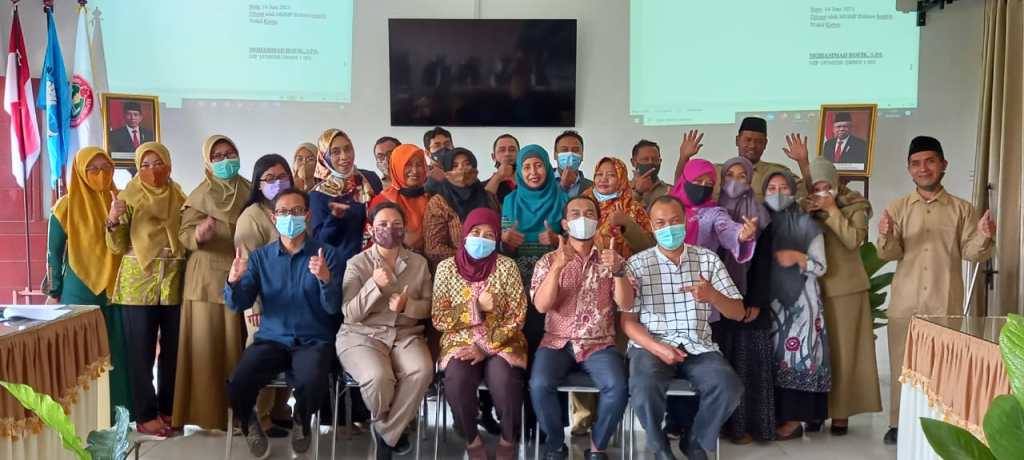
Catatan Kaki: Tulisan ini saya upload karena pagi ini ada undangan acara MGMP Guru Bahasa Inggris SMP/MTs Kota Batu. Hadir di acara tersebut membuat saya teringat tulisan beberapa tahun lalu ketika menyelesaikan tugas mata kuliah “School Improvement” yang diampu oleh salah satu profesor favorit saya Mel West.
 Coretan Thalut